Line Art of Students and Teachers: A Minimalist Approach to Educational Illustrations
In the world of visual communication, simplicity often speaks louder than complexity. This is especially true in educational contexts where clarity and focus are essential. One such visual tool that has gained popularity is the line art of students and teachers, particularly in its minimalist form. These clean, black-and-white illustrations offer a unique way to represent educational activities without the distraction of color or detailed features.
Whether you're designing a presentation, creating an infographic, or developing content for online learning platforms, minimalist line art can be a powerful asset. This article explores the concept of line art featuring students and teachers, its purpose, and how it can be effectively used in various educational settings.
What Is Line Art of Students and Teachers?
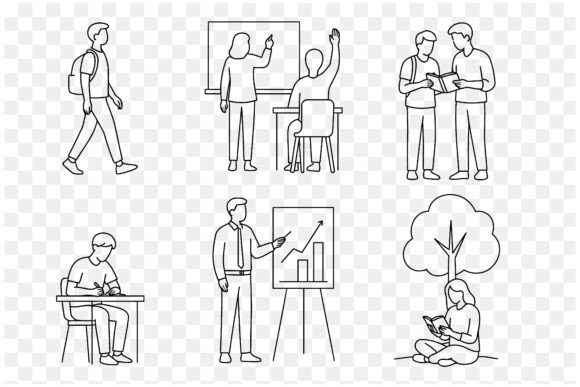
Line art refers to illustrations that use only lines to define shapes and forms. When applied to students and teachers, this style typically omits facial details, focusing instead on the actions and interactions that occur in educational environments. The result is a set of images that are both visually appealing and functionally useful.
The minimalist approach ensures that the viewer's attention is drawn to the activity rather than the individuals involved. For example, a student reading under a tree or a teacher using charts to explain a concept becomes the central focus, not the specific person performing the action.
Key Features of Minimalist Line Art
- Black and White: The absence of color allows for greater versatility in design and emphasizes the structure of the illustration.
- Faceless Figures: By omitting faces, the art remains neutral and inclusive, making it suitable for a wide range of audiences.
- Simplified Shapes: Basic geometric forms and outlines convey the essence of each scene without unnecessary detail.
- Focus on Action: The art highlights what is happening rather than who is doing it, reinforcing the educational theme.
The Purpose and Significance of Line Art in Education
Minimalist line art serves multiple purposes in educational settings. It can be used to illustrate concepts, simplify complex ideas, and create a cohesive visual language across different materials. Its significance lies in its ability to communicate effectively without overwhelming the viewer.
One of the main benefits of this style is its adaptability. Whether you're creating a PowerPoint slide, a brochure, or a digital course module, these illustrations can be easily integrated into various formats. Their simplicity also makes them ideal for international audiences, as they avoid cultural or linguistic biases.
How Line Art Enhances Learning Experiences
- Visual Clarity: By reducing visual noise, line art helps learners focus on the key message or concept being presented.
- Emotional Neutrality: Faceless figures allow for a more objective representation of educational scenarios, which can be beneficial in sensitive or diverse environments.
- Brand Consistency: For institutions like universities or tutoring services, using a consistent visual style reinforces brand identity and professionalism.
- Accessibility: Black and white illustrations are often more accessible for individuals with visual impairments or those using screen readers.
Practical Applications of Line Art in Modern Education
The use of line art in education extends beyond just visual design. It plays a role in how information is presented, understood, and retained. Here are some practical applications:
1. School Presentations: Teachers can use these illustrations to make their lessons more engaging. A diagram showing students working in groups or a teacher explaining a concept with charts can help break up text-heavy slides and maintain student interest.
2. Online Learning Platforms: As e-learning continues to grow, visual elements are crucial for keeping learners engaged. Line art can be used to depict virtual classrooms, study sessions, or collaborative projects, making the content more relatable and easier to follow.
3. Teacher Resources: Educators often need materials that are easy to customize and adapt. Line art provides a flexible base that can be modified to suit different lesson plans or classroom needs.
4. University Marketing: Universities and colleges can use these illustrations in brochures, websites, and social media to showcase their academic environment in a clean and professional manner.
5. Tutoring Services: Private tutors and educational consultants may use line art to create visual guides or study aids that help students grasp difficult topics through simple, clear imagery.
6. Academic Infographics: Infographics are widely used to present data and research findings. Line art can be incorporated into these designs to illustrate processes, trends, or educational milestones in a visually compelling way.
Common Misconceptions About Line Art
Despite its growing popularity, there are some common misconceptions about the use of line art in education. One of the most frequent is that it lacks depth or emotional impact. However, this is not the case. While the figures are faceless, the actions depicted—such as a student asking a question or a group studying together—can evoke a strong sense of connection and engagement.
Another misconception is that minimalist art is too basic or uninteresting. In reality, the simplicity of line art allows for creative interpretation and can be adapted to fit a wide range of styles and themes. It’s not about limiting creativity but about focusing on what truly matters: the message and the experience.
Conclusion
Line art of students and teachers, particularly in its minimalist form, offers a powerful and versatile tool for educators, designers, and content creators. Its clean, black-and-white style promotes clarity, inclusivity, and adaptability, making it an excellent choice for a variety of educational applications.
Whether you're preparing a presentation, designing an infographic, or developing digital learning materials, incorporating line art can enhance the visual appeal and effectiveness of your work. By focusing on the actions and interactions that define the educational experience, these illustrations provide a meaningful and engaging way to communicate ideas.
As the demand for visual content continues to grow, understanding and utilizing tools like line art will become increasingly important. By embracing this style, educators and designers can create materials that are not only informative but also visually compelling and universally accessible.