Genetic Infographics PowerPoint Template
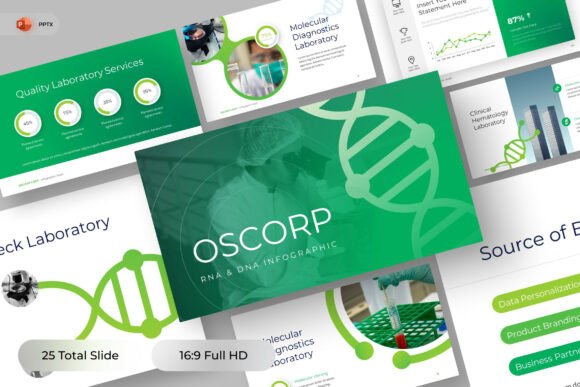
If you’ve ever spent hours wrestling with clipart DNA helices, mismatched color schemes, or clunky text boxes while building a biology presentation—you’re not alone. The Genetic Infographics PowerPoint Template solves that. It’s a science-focused, ready-to-use deck built for clarity, credibility, and visual precision—not decorative distraction. Think clean vector illustrations of double-stranded DNA, stylized RNA ribbons, chromosome diagrams, and molecular pathways—all designed as editable infographic elements, not static images. The aesthetic is modern but grounded: structured enough for peer-reviewed research, approachable enough for high school classrooms, and flexible enough for investor-facing healthcare reports.
A Template That Speaks Science—Without the Jargon
This isn’t a “science-themed” template dressed up with stock beakers and lab coats. Its personality comes from intentional design decisions: balanced negative space, consistent stroke weights in icons, subtle gradient overlays on cellular diagrams, and a restrained palette anchored in deep blues, muted teals, and warm greys. There’s no forced “futurism” or cartoonish simplification. Instead, it supports complexity—whether you’re mapping gene expression patterns or explaining CRISPR-Cas9 mechanisms—without overwhelming your audience. The 16:9 widescreen ratio fits modern projectors and Zoom screens alike, and every slide is fully editable in PowerPoint: swap colors, adjust labels, reposition elements, or insert your own microscopy data directly into placeholders.
Where This Template Fits—Beyond the Lab
While its DNA motifs make it ideal for academic biology lessons or clinical trial summaries, its real strength lies in versatility. A health-tech startup can use Slide 7’s customizable pathway diagram to visualize patient journey touchpoints. A science communicator might adapt Slide 12’s layered cell structure graphic for an Instagram carousel explaining mRNA vaccine mechanics. Publishers building educational workbooks appreciate how the clean typography hierarchy guides readers through dense concepts without relying on bullet-point fatigue. Even non-scientific creators benefit: a sustainability brand could repurpose the chromosomal alignment layout to map stakeholder relationships, or a podcast producer might use the RNA strand motif as a subtle audio waveform visual in show notes.
The Font Factor: Clarity Over Character
The template includes a free, open-licensed sans serif font—clean, neutral, and highly legible at small sizes. It’s not a “creative font” in the display or script sense; it’s a functional workhorse. That’s deliberate. In scientific communication, readability trumps stylistic flair. This font excels in body text across slides, speaker notes, handouts, and exported PDFs. It maintains strong visual hierarchy: bold weights define section headers, regular weights support explanatory paragraphs, and light variants work well for citations or data labels. Crucially, it scales cleanly across devices—no pixelation on retina displays or blurriness when projected in large venues.
It’s not meant for logos or social media banners where personality matters more than precision. But for editorial design (think white papers or grant applications), web design (embedded presentation previews), or packaging design (e.g., educational kits with companion decks), this font reinforces professionalism through consistency. Audiences subconsciously associate clear, uniform typography with trustworthy content—especially in fields where accuracy impacts decisions, outcomes, or policy.
Testing Fit Before You Commit
Before dropping the Genetic Infographics PowerPoint Template into your next project, ask three practical questions:
- Does your content rely on visual explanation? If your message hinges on comparing protein folding models or illustrating inheritance patterns, this template’s pre-built infographic frames save hours—and reduce misinterpretation risk.
- Is your audience time-constrained? Clinicians reviewing a new diagnostic protocol or teachers preparing for back-to-school don’t need to decode design. This template’s intuitive layout means less cognitive load and faster comprehension.
- Do you need full control—not just aesthetics? Since all graphics are native PowerPoint shapes (not flattened PNGs), you can ungroup, recolor, resize, or annotate them without quality loss. That’s essential for iterative feedback loops with co-authors or compliance reviewers.
Test it with your actual content: paste in a dense paragraph from your draft report and see how the font handles line breaks and hyphenation. Drop in a real dataset and check if chart placeholders scale cleanly. Try changing the primary color to match your institutional branding—does the DNA icon retain contrast? These aren’t theoretical checks. They’re the difference between a polished delivery and last-minute formatting panic.
Licensing, Assets, and Realistic Expectations
The package delivers what it promises: editable PowerPoint files, a concise help guide (not a 50-page manual), and zero hidden subscriptions. Importantly, image stocks aren’t included—so you’ll source your own microscopy photos or patient illustrations. That’s actually a strength: it prevents accidental copyright issues and encourages intentionality about which visuals truly support your narrative. The included font carries a free commercial license, meaning you can use it in client presentations, published reports, or internal training—no attribution required.
What it doesn’t do—and shouldn’t—is replace subject-matter expertise. A beautifully rendered CRISPR diagram won’t compensate for outdated methodology descriptions. Use it as a tool, not a crutch. Pair it thoughtfully: if your brand uses a distinctive serif for headlines, swap the template’s title font while keeping the body font intact for readability. If you’re embedding slides into a Keynote deck, test animation triggers first—they behave differently across platforms.
In short, the Genetic Infographics PowerPoint Template works because it respects both the science and the storyteller. It doesn’t shout. It clarifies. And in an age of information overload—especially in high-stakes fields like medicine and education—that quiet precision is rare, valuable, and deeply human.