Gold Finance 3D Icon Set
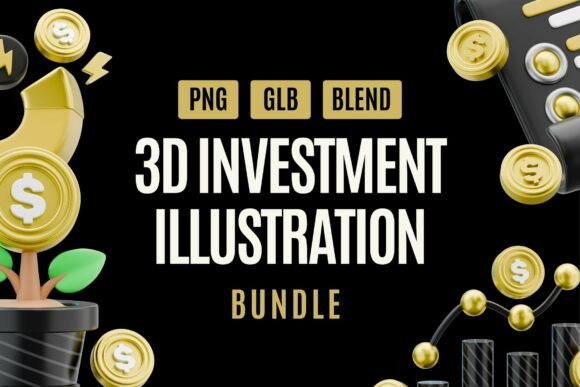
In today’s visually saturated digital landscape, credibility in finance and business communication isn’t just about what you say—it’s about how confidently and cohesively you present it. The Gold Finance 3D Icon Set responds directly to this shift: a thoughtfully crafted bundle of 3D investment illustrations that merge aesthetic sophistication with functional precision. It’s not merely a collection of icons—it’s a visual language upgrade for anyone communicating value, growth, risk, or return.
Why realistic 3D finance visuals matter now more than ever
Users scroll faster, decide quicker, and trust less—especially when financial claims are involved. A flat, generic dollar sign or clipart-style chart no longer signals authority; it raises quiet questions about depth and attention to detail. Meanwhile, 3D rendering tools have become more accessible, and audiences—across websites, investor decks, fintech apps, and even social explainers—now expect richer, more tactile visual cues. This isn’t about chasing novelty. It’s about aligning design fidelity with audience expectations: if your content discusses compound growth or portfolio diversification, your visuals should reflect the same level of nuance and intention.
The Gold Finance 3D Icon Set meets that expectation without overcomplication. Its gold-and-black palette isn’t just decorative—it taps into widely recognized associations: gold conveys stability, value, and premium quality; black adds contrast, clarity, and modern restraint. More importantly, each icon is lit and textured to feel physically grounded—subtle highlights on a coin’s edge, soft shadows beneath a bar chart, realistic gloss on a credit card surface. These aren’t stylized abstractions. They’re objects you could almost hold—and that subtle realism builds subconscious trust.
Designed for real workflows—not just inspiration boards
Creative professionals rarely work in isolation. A marketer building a LinkedIn carousel might start in Canva, hand off assets to a developer integrating interactive charts, then pass final visuals to a motion designer adding micro-animations in After Effects. That’s why format flexibility matters: PNGs for quick web use, GLB files for embedding in web-based 3D viewers or AR experiences, and BLEND files for full editability in Blender. No re-exporting gymnastics. No lost lighting or texture fidelity when switching contexts.
Take an insurance explainer video, for example. Instead of layering flat vectors over stock footage, you can animate a rotating 3D shield icon—its metallic surface catching light as it spins—then cut to a dynamic 3D graph rising behind it. Or imagine a SaaS dashboard where users hover over a “Portfolio Performance” tab and see a subtle 3D coin icon tilt and gleam. These small moments don’t require Hollywood budgets—but they do require assets built for interoperability, not just static display.
More than aesthetics: how texture and lighting shape perception
Consider two versions of the same concept: a flat, vector-based calculator icon versus the one included in the Gold Finance 3D Icon Set. The difference isn’t just dimensionality—it’s information density. The 3D version conveys material (brushed metal keys), depth (slight bevel on the screen), and context (soft ambient light suggesting a professional workspace). That extra layer of visual information reduces cognitive load: viewers grasp function and tone in under two seconds.
This is especially critical in global or multilingual contexts. A well-lit, realistically rendered investment graph communicates trend and scale more universally than text-heavy annotations. Similarly, a 3D credit card icon—featuring embossed numbers and a subtle chip glint—immediately signals security and legitimacy, bypassing translation barriers entirely. In finance, where ambiguity carries real consequences, clarity isn’t optional. It’s foundational.
Practical integration across roles and tools
Designers using Figma can drag and drop PNGs for rapid prototyping, then swap in GLB previews for stakeholder walkthroughs. Educators building online courses on personal finance can embed animated 3D coins into LMS slides to illustrate inflation concepts—without needing coding skills. Freelancers pitching to fintech startups can include a polished, cohesive set of UI elements (a 3D calculator + chart + wallet) in their portfolio, demonstrating fluency with both form and financial narrative.
Even non-designers benefit. A small-business owner updating their website’s “Services” page can replace generic stock icons with the Gold Finance 3D Icon Set’s insurance shield or growth arrow—immediately elevating perceived professionalism. No design degree required. Just drag, resize, and publish.
What’s inside—and why each element serves a purpose
- Gold coins: Not just decorative—they symbolize tangible value, savings milestones, or ROI. Ideal for progress trackers or reward systems.
- Investment graphs: Rendered with depth and axis clarity, making them usable in presentations where data storytelling matters more than raw numbers.
- Calculators: Designed with tactile key feedback in mind—useful for financial literacy tools or loan estimator interfaces.
- Credit cards: Feature realistic chip placement and embossing, supporting trust-building in payment-related flows.
- Insurance shields: Balanced between symbolism and simplicity—recognizable at small sizes, meaningful at larger ones.
Each of the 10 illustrations was developed with cross-platform legibility in mind. They scale cleanly from favicon size to full-screen hero sections. And because they’re built with consistent lighting direction and material logic, mixing and matching feels intentional—not like assembling mismatched parts.
Beyond trends: sustainability in visual resource use
Many creators cycle through free icon packs, only to discard them when branding evolves or platforms update. The Gold Finance 3D Icon Set offers longevity: its restrained color palette avoids fleeting trends (no neon gradients or glassmorphism overload), and its 3D foundation means it adapts naturally to future interface styles—whether that’s spatial computing interfaces, AI-powered dashboards, or immersive investor briefings. You’re not buying a moment—you’re investing in a visual vocabulary that grows with your work.
That said, it’s not about hoarding assets. It’s about having the right tool ready when credibility hinges on a single frame—a pitch deck slide, a landing page CTA, a client report cover. In those moments, a convincingly lit, professionally modeled 3D icon doesn’t just look better. It communicates competence before a word is read.
Who benefits—and how quietly
A blogger explaining index funds might use the 3D chart icon to open a post—creating immediate visual alignment between topic and tone. A university lecturer preparing a lecture on behavioral finance could insert the gold coin icon beside a discussion of mental accounting, reinforcing the concept without explanation. A mobile app developer building a budgeting tool might use the calculator and wallet icons as interactive states—adding subtle rotation on tap to signal responsiveness.
None of these uses demand mastery of 3D software. They rely instead on thoughtful asset design: predictable proportions, consistent perspective, and intuitive naming. That’s the quiet power of the Gold Finance 3D Icon Set—not flash, but function amplified by form.
Ultimately, finance isn’t abstract. It’s decisions, consequences, goals, and people. Visuals that reflect that human dimension—through texture, light, and intelligent design—don’t just decorate ideas. They help them land.